
Antigua & Barbuda's Sea Turtles
Sea turtles have roamed the oceans for over 100 million years, playing a vital role in maintaining the health of marine ecosystems. Globally, there are seven species of sea turtles: Leatherback, Green, Hawksbill, Loggerhead, Olive Ridley, Kemp's Ridle, and flatback turtle. While each species has unique characteristics and habitats, they all face similar threats, making conservation efforts crucial.
Antigua and Barbuda are fortunate to host three nesting species: Hawksbill, Green, and Leatherback turtles. These magnificent creatures choose our beaches as nesting grounds, continuing an ancient life cycle. Hawksbills are the most common nesters, often found on coral-fringed beaches. Green turtles favor sandy beaches with abundant seagrass nearby for feeding, while leatherbacks, the largest of all sea turtles, prefer the more secluded stretches of coastline to lay their eggs.
Although loggerhead and olive ridley turtles do not nest here, they are occasional visitors to our waters, passing through during their long migrations. These encounters are a reminder of the interconnectedness of ocean ecosystems and the importance of safeguarding sea turtle habitats beyond nesting beaches.
By protecting these species and their habitats, Antigua and Barbuda play an important role in global conservation efforts. Learning more about these ancient mariners is the first step in ensuring their survival for generations to come.

Leatherback

Dermochelys Coriacea
Size: 1 - 2.5 meters / 3.5 - 7.75 feet
Weight: 250 - 700 kg / 600 - 1500 lbs
Lifespan: 50+ years
Diet: Jellyfish and soft bodied invertabrates
Nesting Season: March - June
Nests per season: 2 - 10
Clutch size: 60 - 90 eggs
Incubation Period: 60 - 70 days
IUCN Red List Status: Vulnerable, population decreasing.
The leatherback is the largest sea turtle in the ocean, with a lineage as old as the dinosaurs, dating back over 100 million years. With its distinctive rubbery blue-grey skin, leatherbacks are the only sea turtle to not have a hard shell. Their massive size and unique appearance make them truly unforgettable, but their extraordinary abilities are just as awe-inspiring.
We call them "The Explorers" because they are remarkable travelers and divers. They are the fastest of all the swimming turtles in the world. They can reach speeds of up to 35 kilometers per hour (21.7 miles per hour). This impressive speed is due to their streamlined bodies, large flippers, and unique physiology, making them exceptional swimmers as they migrate vast distances across the oceans.
Leatherbacks are also the deepest diving reptile in the world, their compressible body allows them to dive up to 1,200 m/4,000 ft, in search of their favourite food, jellyfish. These amazing sea turtles will travel over 16,000 km / 10,000 miles annually as they migrate between feeding and nesting grounds.

Hawksbill

Eretmochelys Imbricata
Size: 0.8 meters / 2.5 feet
Weight: 45-68 kg / 100- 150 lbs
Lifespan: 50+ years
Diet: Sea sponges, jellyfish, crabs and clams
Nesting Season: May - October
Nests per season: 3 - 5
Clutch size: 130 - 180 eggs
Incubation Period: 60 days
IUCN Red List Status: Vulnerable, population decreasing.
Fireworks! That’s the easiest way to recognize these stunning swimmers. The pattern on their carapace (shell) is painted with contrasting colours, resembling an explosive light show in the night sky. Paired with their hawk-like beak, from which they get their name, Hawksbill turtles can be spotted exploring around Antigua's coral reefs.
That sharp pointy beak serves a very important purpose in our ocean ecosystem which is why we call Hawksbill's "The Architects," because they keep the coral reefs healthy as they feed on sea sponges hidden within the reef’s nooks and crannies. Keeping the sponges in check allows better access to the coral for other species like parrot fish and sea urchins who are also important to keeping our reef systems healthy.
Hawksbill sea turtles are among the smaller species of sea turtles, typically growing to about 2.5 to 3 feet in length and weighing between 100 and 150 pounds. Their size does not diminish their impact—rather, it highlights their ability to navigate the intricate coral environments and help create the spaces that sustain diverse marine life.
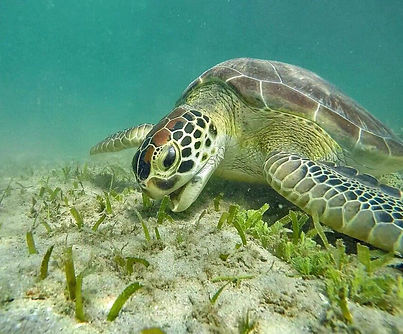
Green

Chelonia Mydas
Size: 0.9 - 1.2 meters / 3 - 4 feet
Weight: 130 - 200kg / 300 - 400lbs
Lifespan: 70+ years
Diet: Seagrass, algae, mangrove leaves & shoots
Nesting Season: May - October
Nests per season: 3 - 5
Clutch size: 70 - 110 eggs
Incubation Period: 60 days
IUCN Red List Status: Endangered, population decreasing.
It's Crush, from Finding Nemo!
Did you know that green sea turtles get their name not from their shell color but from the green layer of fat beneath it? These turtles are one of the few herbivorous sea turtles, primarily feeding on seagrass and algae, which helps maintain healthy marine environments. Their teardrop-shaped shells come in various shades of brown, black, gray, olive green, and yellow. They also have a flat, short mouth, separating them from other sea turtles.
We call green turtles “The Landscapers” because of their crucial role in maintaining seagrass beds. By "mowing the lawn" in calm harbors, they create perfect habitats for species like starfish and sea cucumbers to flourish. Without green turtles, the waters in places like Deep Bay, Galleon Bay, and Falmouth Harbour in Antigua would turn cloudy and murky, disrupting the balance of the entire ecosystem.
These gentle giants are the second largest sea turtle species and can grow to an impressive size, weighing up to 400 pounds (180 kg) and reaching lengths of over 4 feet (1.2 meters).